Historic Landmarks
Davie County’s historic landmarks tell the story of a community shaped by its role as a rural courthouse seat, a crossroads for early settlers, and a participant in the Civil War. From the imposing Classical Revival courthouse in Mocksville to the preserved storefronts of the downtown district, these sites remain anchors of county identity.
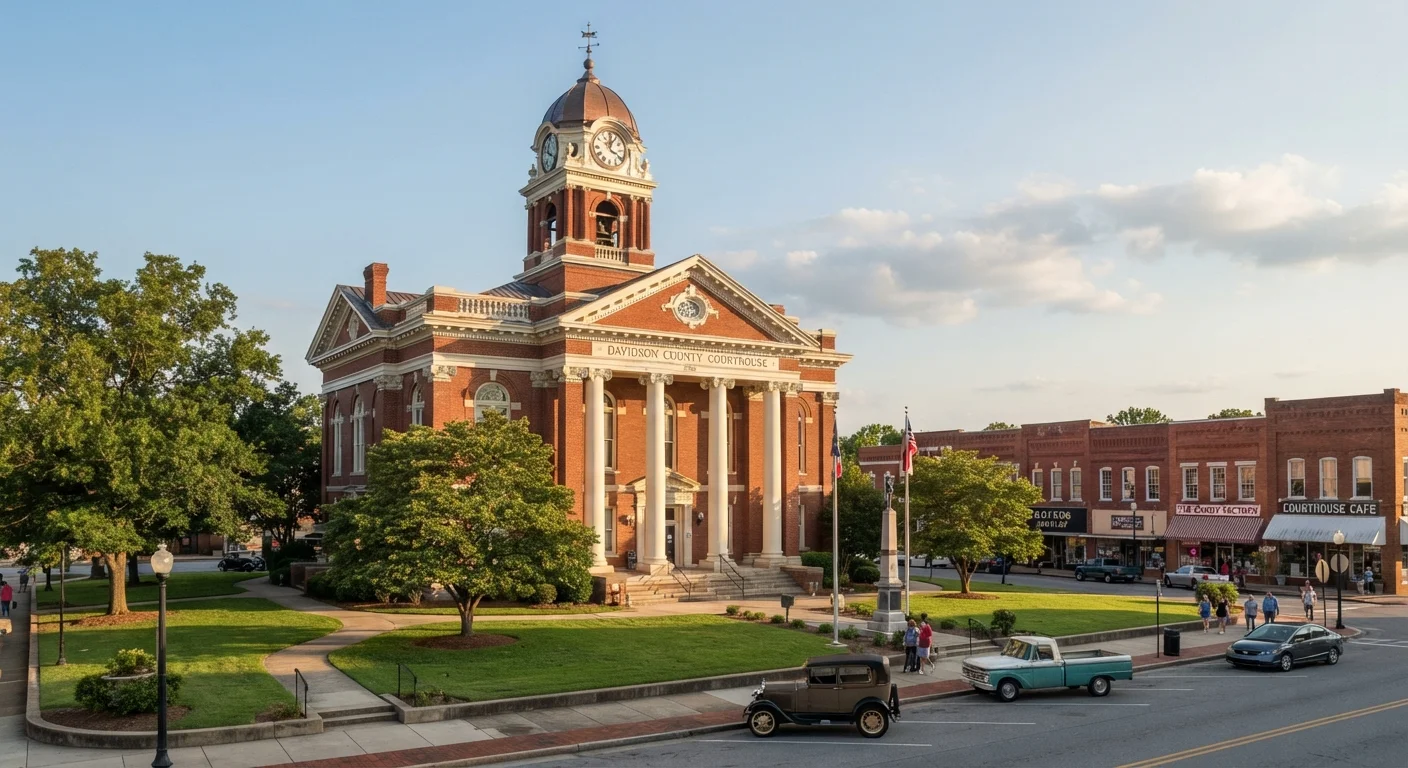
Davie County Courthouse
Completed in 1909, the Davie County Courthouse stands at the center of the Mocksville town square as the county’s most recognizable landmark. Designed in the Classical Revival style, the building features a prominent two-story portico supported by fluted Ionic columns, a brick-and-stone façade, and a central clock tower that rises above the downtown skyline. The courthouse replaced an earlier 1836 structure and was built on land donated by the family of Daniel Boone’s parents, who settled in the area in the 1750s. The interior retains its original courtroom with pressed-tin ceilings, oak benches, and a presiding judge’s bench crafted from local walnut. The building was listed on the National Register of Historic Places in 1979 and underwent a major restoration in 2002 that preserved its original woodwork and hardware.
Old Davie County Jail
Located just one block north of the courthouse square, the Old Davie County Jail is a fortress-like brick structure built in 1890. The jail served as the county’s detention facility for nearly a century, housing prisoners in cramped cells on the second floor while the sheriff’s family lived in a residence on the ground floor—a common arrangement in small Southern towns. The building’s heavy iron doors, barred windows, and thick masonry walls reflect the penal philosophy of the late 19th century. After the jail was decommissioned in the 1980s, the building was acquired by the Davie County Historical and Genealogical Society, which now maintains it as a museum and archive. Visitors can tour the cell blocks, view historical artifacts, and research local genealogy in the society’s collection of court records, newspapers, and family histories.
Mocksville Historic Downtown District
The Mocksville Historic Downtown District encompasses roughly two dozen buildings along Main Street and Depot Street, most dating from the 1870s to the 1920s. The district preserves the appearance of a late-19th-century Piedmont market town, with brick commercial buildings featuring cast-iron storefronts, decorative cornices, and recessed doorways. Notable structures include the 1890s-era Masonic Lodge building, the old Mocksville Depot built by the Cape Fear and Yadkin Valley Railway, and the W. E. B. Jones Store, a general merchandise establishment that operated for more than sixty years. The district was listed on the National Register in 1992, and many of the buildings have been rehabilitated for modern use while preserving their historic character.
Depot Street
Anchored by the restored Mocksville Depot, this block once hummed with freight and passenger traffic on the Cape Fear and Yadkin Valley line. The depot now houses a visitors’ center with exhibits on railroad history.
Main Street
The heart of the district, lined with two- and three-story brick buildings from the 1880s–1920s. Many retain original pressed-metal ceilings, tin roofs, and display windows with transom lights.
Courthouse Square
Anchored by the 1909 courthouse, the square has been the commercial and civic center since Davie County was formed in 1836. It hosts the annual Mocksville Christmas Parade and summer concert series.
Homes & Architecture
Davie County’s residential architecture spans more than 150 years, from Federal-style farmhouses of the early 1800s to Victorian-era cottages and Colonial Revival estates of the early 20th century. Scattered across the county’s rolling hills and bottomlands, these homes reflect the economic and social history of the families who built them.
Brock-Lazarus House
The Brock-Lazarus House, located on Cemetery Street in Mocksville, is one of the finest examples of Greek Revival residential architecture in the county. Built around 1850 for Dr. John Brock, a prominent local physician and planter, the house features a symmetrical front façade with a central pedimented portico supported by square columns, a transom-lit front door, and six-over-six sash windows with louvered shutters. The interior retains original mantels, plaster crown moldings, and wide heart-pine flooring. After the Brock family, the house was owned by the Lazarus family, who operated a general store in downtown Mocksville. The property was listed on the National Register of Historic Places in 1975 and is now operated as a historic house museum, furnished with period antiques and family artifacts.
Plantation Homes and Creekside Estates
Along the creeks and river bottoms of Davie County, several plantation homes survive from the antebellum period. These houses were typically set on large tracts of land farmed by enslaved and later free laborers, producing tobacco, wheat, and corn. The Creekside plantation complex, located along the South Yadkin River, includes a two-story Federal-style main house built of hand-made brick with Flemish bond brickwork, a hallmark of skilled 18th-century masons. The property retains a detached kitchen, a smokehouse, and a family cemetery. Other plantation homes in the county, such as the Oak Grove and Walnut Grove estates, blend Federal and Greek Revival elements, with wide central halls, interior end chimneys, and rear porches overlooking the surrounding farmland.
Historic Farmsteads
Throughout the county, historic farmsteads tell the story of Davie County’s agricultural heritage. Many of these properties consist of a main house, a barn, a springhouse or well, and various outbuildings arranged around a farmyard. Architectural styles range from simple log cabins and frame cottages to more elaborate Gothic Revival houses with scalloped bargeboards and gingerbread trim. The J. A. H. Stauber Farm, built in the 1870s near the Yadkin River, is a well-preserved example of a Victorian-era farm complex with a two-story frame house, a bank barn built into a hillside, and a collection of original outbuildings including a corn crib, a tool shed, and a smokehouse. These farmsteads are increasingly rare as modern development transforms the rural landscape, and preservation efforts seek to document and protect the most significant examples.
Churches & Cemeteries
Davie County’s churches and cemeteries are among its most important historical resources. They preserve the names of early settlers, the evolution of religious life in the Piedmont, and the architectural traditions of rural congregations.
Joppa Cemetery
Joppa Cemetery, located on a wooded hillside south of Mocksville, is one of the oldest burial grounds in Davie County. The earliest marked graves date to the 1770s, when the area was still part of Rowan County. The cemetery contains the remains of Revolutionary War soldiers, early county officials, and members of the region’s founding families—Boone, Davie, and Clement. The oldest section features simple fieldstone markers, many with hand-carved initials and dates that have been worn smooth by two centuries of weather. Later sections include marble and granite headstones with Victorian-era motifs such as weeping willows, clasped hands, and draped urns. Joppa Cemetery is maintained by a dedicated association and remains an active burial ground. The cemetery is the site of an annual memorial service each May, when descendants gather to clean stones and remember those buried there.
Historic Churches
Davie County is home to congregations that trace their roots to the 18th and 19th centuries. Their meeting houses range from simple frame structures to brick Gothic Revival buildings, and many remain active today.
- Center Methodist Church — Founded in the 1790s, Center Methodist is one of the oldest Methodist congregations in the Piedmont. The current sanctuary, built in 1854, is a brick Greek Revival structure with a central bell tower, arched windows, and a sanctuary with a slave gallery still intact. The churchyard contains graves of Confederate veterans, early ministers, and prominent local families.
- Jerusalem Baptist Church — Organized in 1825, Jerusalem Baptist occupies a white frame church built in 1890 on a stone foundation. The church is a center of African American religious life in Davie County and was an important gathering place during the Civil Rights era. The adjacent cemetery holds the graves of community leaders, teachers, and farmers who shaped the county’s history.
- Zion Evangelical Lutheran Church — Established in 1790 by German settlers, Zion Lutheran’s current sanctuary dates from 1902 and features a Gothic Revival design with a steeply pitched roof, lancet windows, and a tall steeple visible from the surrounding countryside. The church maintains German-language records from its earliest years, now preserved in the church archives.
Family Cemeteries
Scattered throughout Davie County’s fields and woodlands are dozens of small family cemeteries, many containing only a handful of graves. These burial grounds preserve the names of early settlers who arrived in the 18th century, often on land grants from the Earl of Granville. The Boone family cemetery, located near the site of Squire Boone’s homestead, contains the graves of Daniel Boone’s parents and several of his siblings. Other family cemeteries—such as the Jones, Clement, and Swaim burying grounds—lie on private property and are maintained by descendants. The Davie County Historical and Genealogical Society has surveyed and documented more than 150 cemeteries and burial grounds across the county, publishing their locations and inscriptions in a series of volumes available for research.
Visiting Today
Davie County’s historic sites are open to the public year-round, with the best visiting conditions from spring through fall. Mocksville’s compact historic district makes it ideal for walking tours, and several museums and organizations offer guided experiences and educational programs.
Self-Guided Walking Tours
The Davie County Historical and Genealogical Society publishes a self-guided walking tour of Mocksville’s historic downtown. The tour covers approximately one mile and includes twenty stops, with informational plaques at each location. Brochures are available at the society’s office in the Old Davie County Jail and at the Mocksville Visitors’ Center in the restored depot. The tour highlights the courthouse, the jail, the Brock-Lazarus House, the Masonic building, and several historic churches and commercial buildings. A companion driving tour explores rural landmarks including historic farmsteads, family cemeteries, and covered bridges.
Davie County Historical Museum
Housed in the Old Davie County Jail, the Davie County Historical Museum features exhibits on the county’s history from the prehistoric period through the 20th century. Displays include Native American artifacts, Civil War memorabilia, antique farm equipment, and a recreated early-1900s general store. The museum’s research library contains census records, marriage and death registers, land grants, and an extensive collection of historic photographs. The museum is open Tuesday through Saturday, with free admission and docent-led tours available by appointment.
Annual Historic Home Tours
Each December, the Davie County Historical and Genealogical Society sponsors a Historic Homes Tour that opens private residences and public buildings to the public. The tour typically features five to seven properties, ranging from antebellum plantation houses to early 20th-century bungalows. Docents in period costume provide commentary on the architecture, furnishings, and history of each property. The tour is one of the society’s primary fundraisers and draws visitors from across the Piedmont region. Tickets go on sale in November and often sell out in advance.
Preservation Efforts
Historic preservation in Davie County is led by the Davie County Historical and Genealogical Society, a nonprofit organization founded in 1970. The society owns and maintains the Old Davie County Jail, the Brock-Lazarus House, and the county’s collection of historic documents and artifacts. It also works with property owners, the county planning department, and the North Carolina State Historic Preservation Office to promote preservation-friendly policies and to secure grant funding for restoration projects. The Mocksville Historic Preservation Commission oversees the downtown historic district, reviewing exterior alterations to ensure they are compatible with the district’s historic character. Local preservation advocates have also succeeded in placing several individual properties on the National Register of Historic Places, providing access to federal tax incentives for rehabilitation.
For current hours, tour schedules, and event information, visit the Davie County Historical and Genealogical Society at the Old Davie County Jail, 221 S. Main Street, Mocksville, or call (336) 751-9270.