Cooleemee
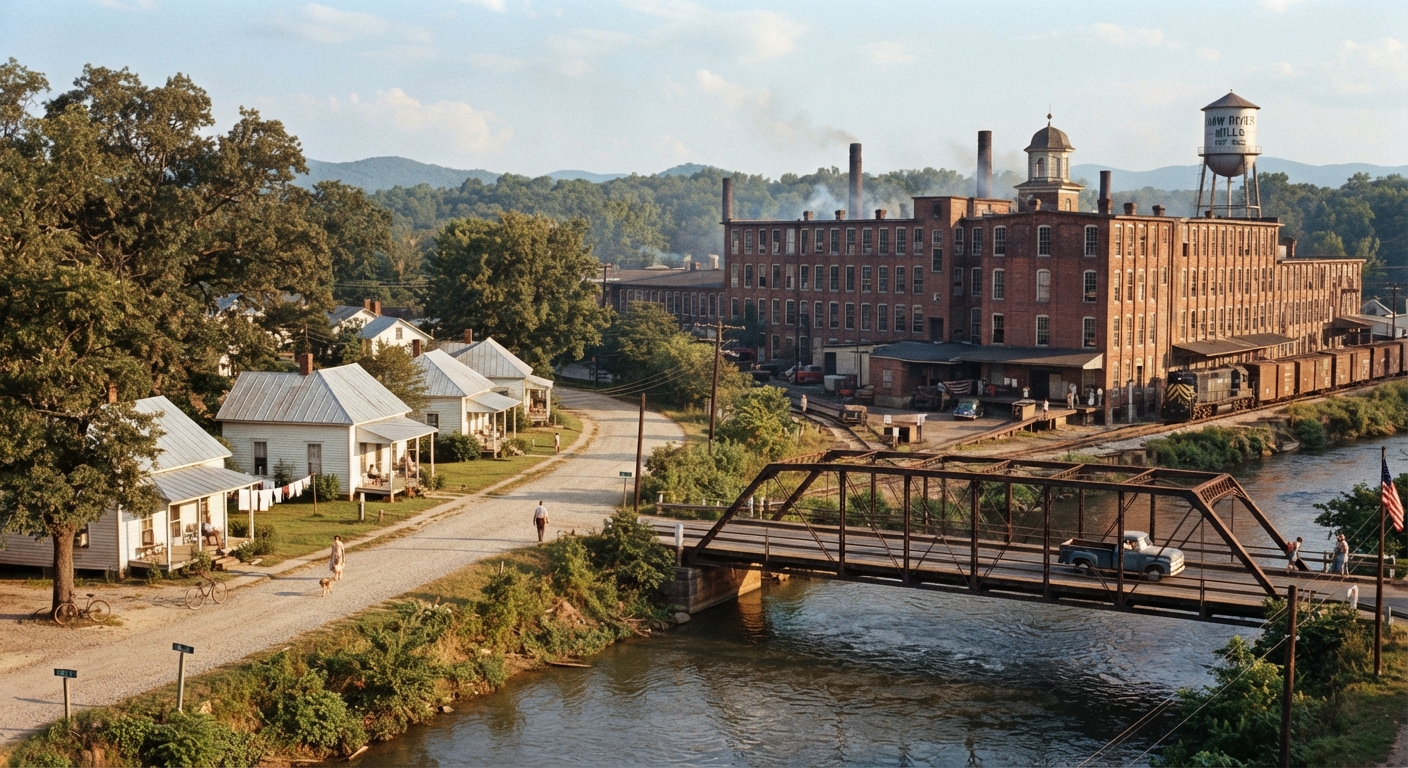
A Mill Town is Born
Few places in Davie County tell their story as clearly as Cooleemee, a town that was literally built around a single idea: the cotton mill. Before the plant was ever finished, the land along the South Yadkin River was quiet farmland. All of that changed in 1898, when the family of Washington Duke — the Erwins, who had grown wealthy in tobacco — chose this spot on the riverbank to raise a sprawling textile factory. The mill they built would grow into one of the largest cotton mills in the state, and the town that rose up beside it would take its character from the hum of the looms.
The name Cooleemee is not a local invention but a borrowed one. It comes from a Native American word, an adaptation of a phrase meaning “the place of the white oak,” borrowed from the name of a plantation in the area. The Erwins carried that name with them, and it stuck to the mill and the community that formed around it — a fitting tribute to the deep history of the land they had chosen.
From the beginning, this was planned as a company town. The Erwins did not simply build a factory and hope workers would find their own way. They laid out streets, put up frame houses for their employees, and organized the whole settlement around the rhythms of the mill. It was a deliberate, optimistic design — a vision of a self-contained community where every family would live within sight of their work, and where the mill would be the heart of nearly everything.
Life in the Mill Village
For generations of families, life in Cooleemee revolved around the company and the clock. The mill village was a tight-knit world of its own, a place where neighbors knew one another by name and where nearly everyone shared the same employer and the same daily routine.
The company built more than just a factory. It put up the homes its workers lived in, the churches where they worshipped, and the school where their children learned. In the early years the village was nearly self-sufficient — it had its own stores where families could buy groceries and supplies, its own barber shop, its own meeting halls, and its own gathering places. Residents rarely needed to travel far for anything.
The day was measured by the mill whistle. It sounded to call workers to their shifts in the morning, to mark the end of the day, and sometimes to signal the change of hands between crews. The rhythm of the whistle became the rhythm of the town itself:
- Families rose before daylight and hurried to the mill gates.
- Shifts ran long through the day, the noise of the looms humming from the brick walls.
- Between shifts, the village came alive — children played in the streets and neighbors traded news on the porches.
- Evenings brought rest, church gatherings, and the simple pleasures of a small community.
It was a hard life by any measure, but it was a shared one. The mill paid wages that kept families together under one roof, and the village fostered a loyalty to the company that ran deep. People who grew up in Cooleemee often remember it not as a factory town but as a neighborhood — a place where the boundaries between work and home, and between one family and the next, were soft and familiar.
The Textile Heritage
Cooleemee reached its peak in the early and middle decades of the twentieth century. Through the First World War, the prosperous 1920s, and even the hard years of the Great Depression, the mill kept running and the town kept growing. At its height the plant employed thousands of workers, and the village bustled with the energy of a thriving industrial community. Cotton moved through the mill in an endless flow — from raw bales at the door to finished cloth on the loading dock — and the town’s fortunes rose and fell with the demand for that cloth.
But the textile industry that had built the South was beginning to change. Through the late twentieth century, manufacturing shifted overseas and across the region, and the mills that had once employed entire towns began to close their doors one by one. Cooleemee was not spared. When the mill finally shut down, the blow to the community was profound. Jobs vanished, families moved away, and the streets that had once hummed with the whistle and the looms grew quiet. Like so many Southern mill towns, Cooleemee had to face the question of what it would become after the factory that had given it life was gone.
The answer was not to forget the past but to honor it. Rather than letting the mill’s story fade, the people of Cooleemee chose to remember the generations who had worked there. The legacy of the textile era is kept alive today by the Textile Heritage Center, which preserves the tools, photographs, and memories of the mill years — ensuring that the skill and sacrifice of those workers are never lost.
Preserving the Story
The work of keeping Cooleemee’s history alive began with the community itself. The Cooleemee Historical Association was founded by residents who were determined to preserve the mill village and the stories of the families who built it. Through their efforts, the town has become recognized as one of North Carolina’s best-preserved mill towns — a place where the old brick factory and the rows of mill houses still stand as a living reminder of a vanished way of life.
At the heart of that effort is the Mill House Museum, a lovingly restored company home that shows visitors what everyday life in the village was like. Walk through its rooms and you can picture a mill family at the turn of the century — the simple furniture, the kitchen where meals were cooked after a long shift, the porch where neighbors gathered in the evening.
Today Cooleemee is a place with one foot in history and one in the present. Its brick mill still rises beside the South Yadkin, its village streets still line up in neat rows, and its people still carry the pride of the families who came before them. For anyone who wants to understand Davie County — and the textile heritage that helped shape the South — Cooleemee is a story worth lingering over.